


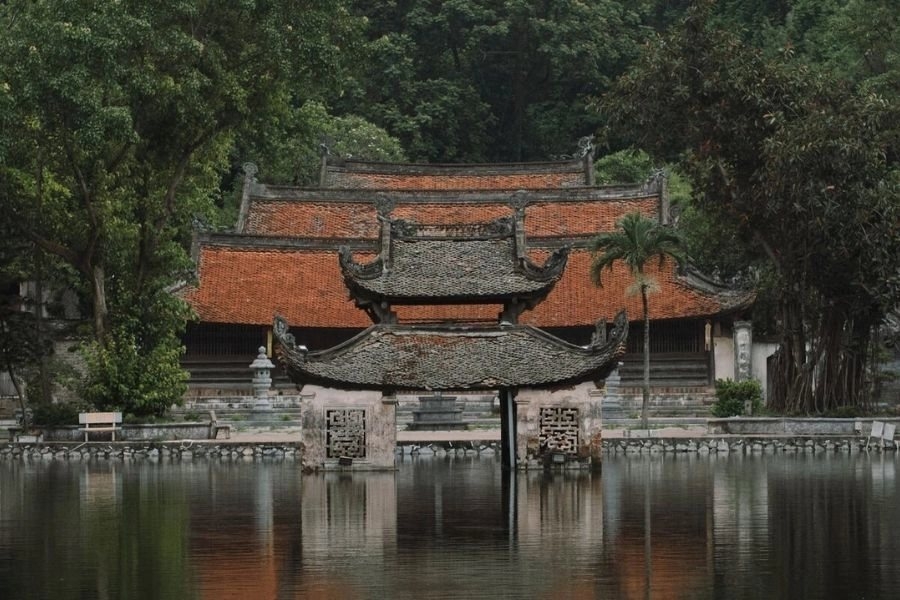
Thầy Pagoda is one of the most well-known ancient pagodas in northern Vietnam. Located at the foot of Sài Sơn Mountain in Sài Sơn Commune, Quốc Oai District, about 25 km west of central Hanoi, the temple is not only a place of Buddhist worship but also closely associated with Zen master Từ Đạo Hạnh — an influential monk of the Lý Dynasty and the legendary founder of traditional Vietnamese water puppetry.
 Time:
Time:  Depart:
  Vehicle:
Location and Landscape

From the entrance, visitors immediately notice the classic Vietnamese spiritual layout known as “water in front – mountain behind.”
- In front lies Long Chiểu Lake, calm and mirror-like
- In the center of the lake stands Thủy Đình, the traditional water-puppet stage
- Behind the complex rises the green limestone slope of Sài Sơn Mountain
The moss-covered curved roofs reflecting on the still water create a peaceful atmosphere rarely found so close to a large city like Hanoi.
Architecture of Thầy Pagoda

The pagoda complex consists of three main halls arranged along a single axis:
- Hạ Pagoda (Lower Hall) – the main ceremonial space
- Trung Pagoda (Middle Hall) – dedicated to Buddhist worship
- Thượng Pagoda (Upper Hall) – dedicated to Zen master Từ Đạo Hạnh
The structures are primarily built with ironwood frames and traditional clay roof tiles. Inside are ancient Buddha statues and intricate wooden carvings. Locals respectfully refer to Từ Đạo Hạnh as “Đức Thầy” (The Master).
Nhật Tiên Bridge and Nguyệt Tiên Bridge

On both sides of Long Chiểu Lake stand two small red covered bridges:
- Nhật Tiên Kiều (Sun Bridge)
- Nguyệt Tiên Kiều (Moon Bridge)
They lead to small island shrines and have become iconic photo spots of the temple. Early morning mist or late afternoon light makes the entire scenery quiet and poetic.
Thầy Pagoda and Water Puppetry
A unique feature of the pagoda is the Thủy Đình water-puppet pavilion in the middle of the lake. According to tradition, Zen master Từ Đạo Hạnh created and taught this art form to villagers. Because of this, the pagoda is considered not only a religious site but also an important cultural cradle of Vietnamese folk performance.
Thầy Pagoda Festival
The annual festival takes place from the 5th to the 7th day of the third lunar month and includes:
- Traditional processions and rituals
- Water-puppet performances
- Folk games and community activities
It is the liveliest time of the year and attracts pilgrims and visitors from across northern Vietnam.
Travel Tips
Best time to visit:
- February to April (spring weather and festival season)
- Early morning or late afternoon for photography and fewer crowds
How to get there from Hanoi:
- Motorbike or car via Thăng Long Boulevard toward Quốc Oai
- Travel time: about 40–60 minutes
Visitor etiquette:
- Dress modestly
- Keep quiet in worship areas
- Avoid littering around the lake


Tour information
Thầy Pagoda – A Timeless Temple Near Hanoi


Sign up for consultation
Contact us
PBJP TRADING & TOURISM SERVICES COMPANY LIMITED
- Address:Office 26, 26th Floor, Song Da Building, No. 110 Tran Phu Street, Ha Dong, Hanoi
- Phone : +84 393 250 295
- Website : pbjptravel.com
Connect with PBJP TRAVEL